Content

tagged: dvi-mixer

DVI Mixer: Project to Product

I’ve wanted a simple, compact VGA mixer for as long as I’ve had a laptop. Something I could fit in the same case as the laptop, and something that wouldn’t render my precise computer imagery through the lens of a 1950’s television: a single pixel line should not end up blurred and flickery when projected on a screen. My need is for live video performance, but anybody who has had to put a powerpoint presentation through their laptop’s tv-out socket or seen the chaos caused by swapping cables in and out of computers in front of an audience should have an idea of just how useful such a thing could be.

I wrote this in 2009, when I had cracked how to co-opt a new bit of AV industry kit into a laptop friendly HD mixer. I wanted to get it out to everybody else I knew who was in the same position as I’d been. In 2012, I finally got there: the *spark d-fuser, backed by trading entity Spark Live Ltd: http://sparklive.net/dfuser

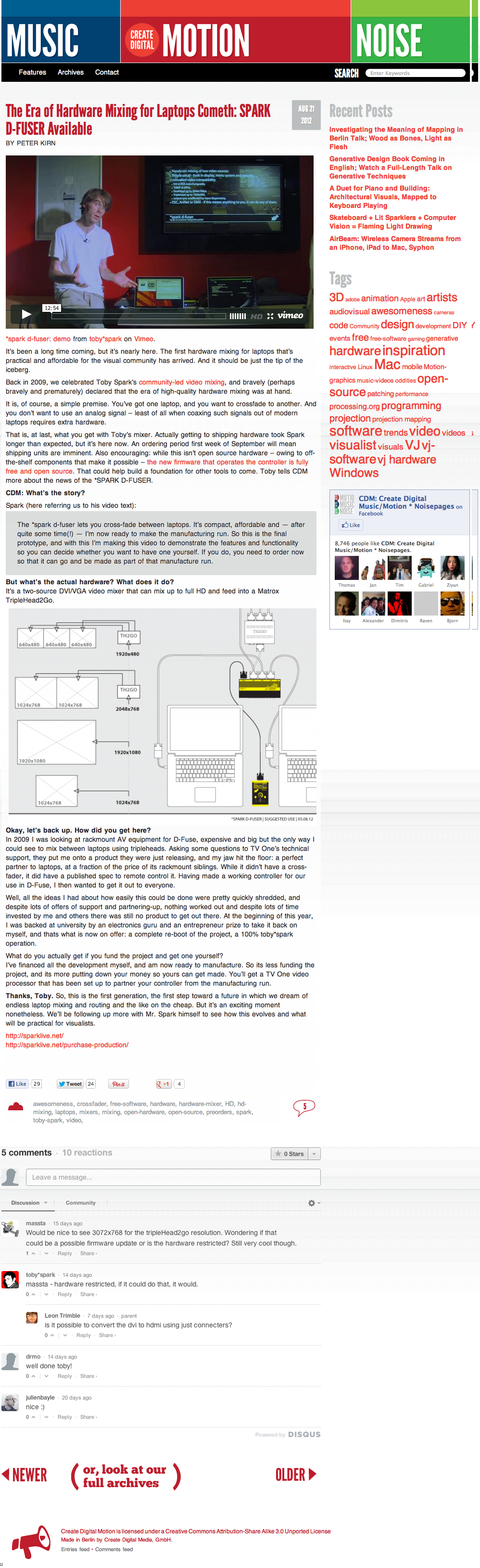
For some at-the-time context, there’s a nice piece on Create Digital Motion reacting to the release announcement: The Era of Hardware Mixing for Laptops Cometh: SPARK D-FUSER Available. And rolling back to the beginning, you can see what I set out to do in the original version of this project page. The opening paragraph was taken from it, and over those pre-release years the page had ~30k reads, by far the most popular here.

The development of the project has made a fair few diary posts, notably the joy of getting the project out there: ripples around the internet; rebooting the project two years later: pcbs, parts, plans redux; and after the successful pre-order run, taking it retail: *spark d-fuser: to retail.

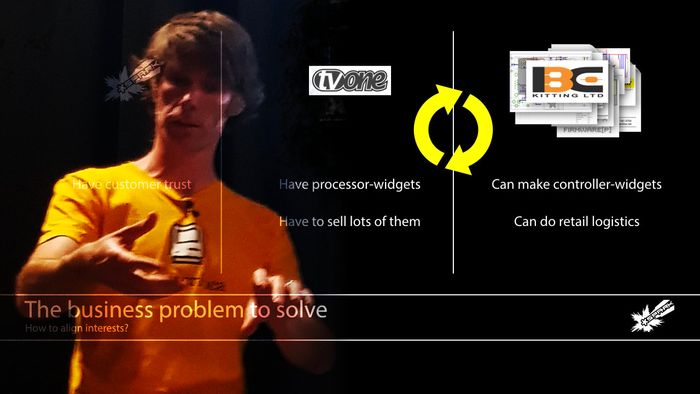
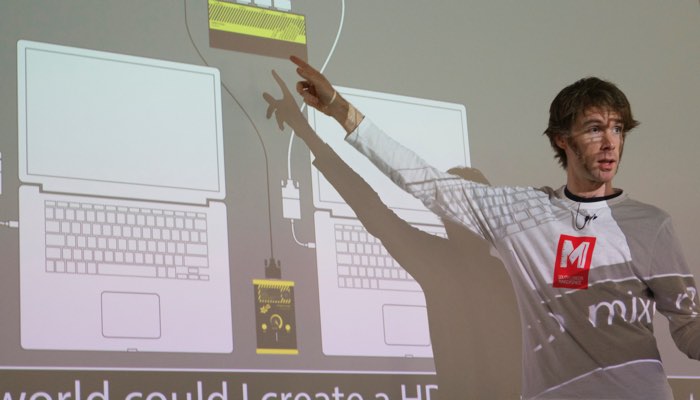
I have a talk about the whole journey. It’s pretty special, I think. It’s also long, but it’s exposing the detail that in part makes it. Anyway, I’d have loved to hear something like this when I was younger – a parable of you-can-do.

Kickstarter pitches are now part of maker culture, but when do you hear back from the other side?
How did an Arduino hack turn into £50k in pre-orders? How do you get an assembly line going if all you have is a laptop? Four production runs and a retail partnership later, what were the final accounts?
Join Toby Harris as he talks product and dissects a successful run of a maker business.
https://tobyz.net/project/taking-stock

Finally, as a follow-up to that talk and the discussion around a product being just a bunch of files made on your computer, here is a zip of what you’d need to make a Spark D-Fuser. Having spent the talk trying to give a very concrete answer to ‘what is a product?’, it’s my most tangible version of that.

project | 2012 | downloads: Spark-DFuser-Source.zip · cdm-dfuser-available.png

DVI Mixer [As of 2009]

Note: this is an archived page, the current version of the DVI Mixer project is at http://tobyz.net/project/dvi-mixer

I’ve wanted a simple, compact VGA mixer for as long as I’ve had a laptop. Something I could fit in the same case as the laptop, and something that wouldn’t render my precise computer imagery through the lens of a 1950’s television: a single pixel line should not end up blurred and flickery when projected on a screen. My need is for live video performance, but anybody who has had to put a powerpoint presentation through their laptop’s tv-out socket or seen the chaos caused by swapping cables in and out of computers in front of an audience should have an idea of just how useful such a thing could be.

With the commercial world still clinging to PAL and NTSC in 2009, may I present the *spark d-fuser project: a video processor and controller capable of handling all the resolutions a VJ might need, processed in 4:4:4 RGB VGA/DVI, that will fit in a 12" laptop case and still have space in there for its natural partner, the Matrox TripleHead2Go. And it won’t break the bank: £750 or so.

This has been possible due to an affordable video processor being released that has the technical capabilities - finally - although out of the box it has no considerations for live, hands-on use. I have put a load of those considerations into a controller you plug into the unit, the idea being you can arrive at the gig, switch to the appropriate video setting, watch your two computers pick up the new output resolution, and then relax knowing you can crossfade between them, and have a fade to black control downstream of your laptop’s output, on a solid signal to the projectors that won’t flicker as the inputs get replugged or computers reboot.

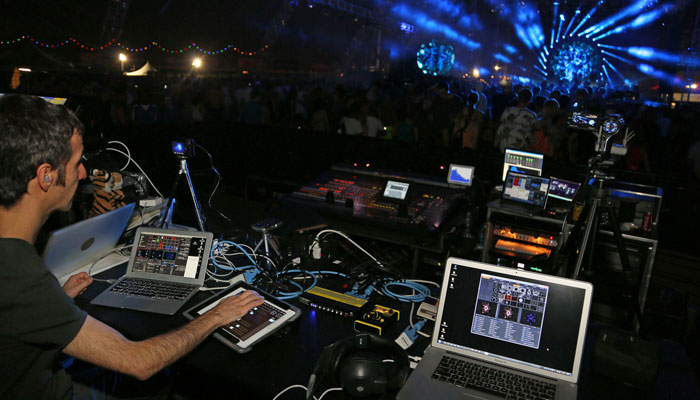
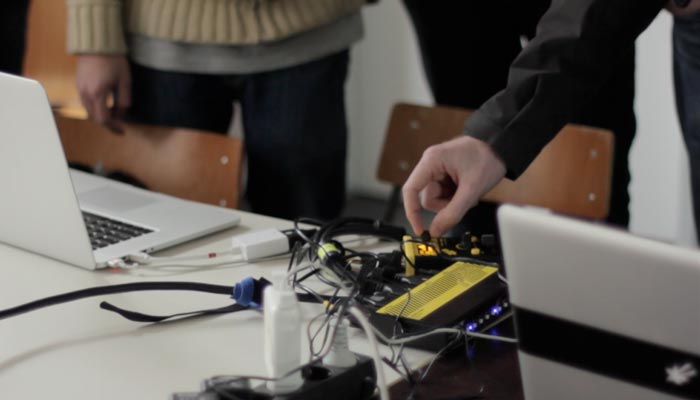
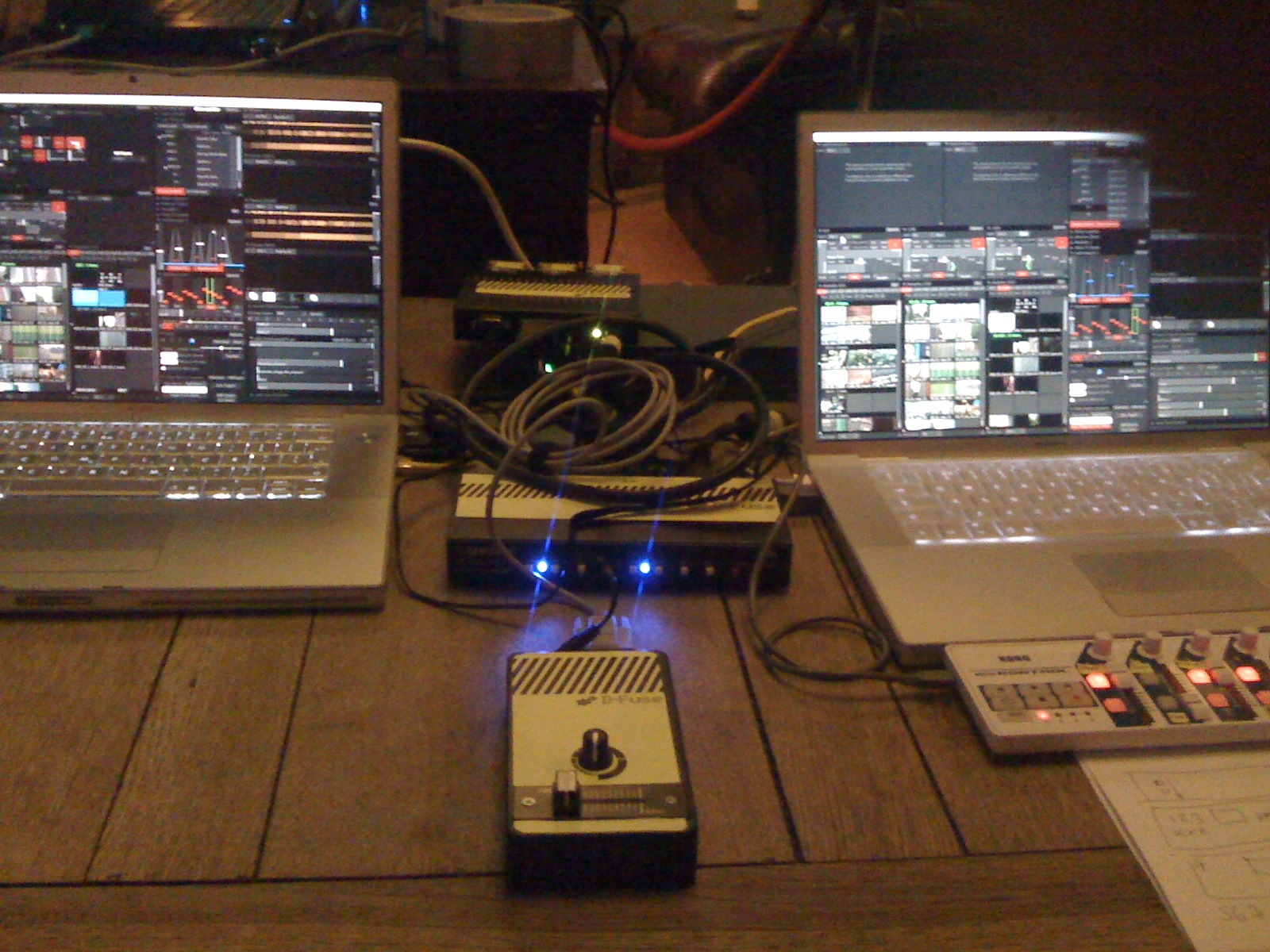
My work on D-Fuse’s new live performance Particle was predicated on having such a box: a laptop sprinkled with custom code was the only way to meet the creative brief, but connecting a single laptop direct to projectors for gigs that can stretch to audiences in the thousands simply wasn’t an option, and while the software based setup allows generation of the complete composition and so the whole show, we still wanted two setups to switch between, tag teaming to develop and pace the performance. So I developed the prototype in July 2009, it had its first public outing at London’s Electrovision event, and we have used it for all the Particle performances since then. Its real, it works.

What takes this beyond a personal project is that as of autumn 2009 I am organising a limited production run of the controllers along in tandem with a officially developed firmware revision for the video processor. I’ve had a lot of enquiries, and anecdotally the pent-up demand in the VJ world is there. The aim is to take that, and be able to facilitate not only a nice bit of crossfader hardware, but use it to get the manufacturer tweak the video processor to serves our needs better. So at the bottom of this page is a sign-up form, and here are the rest of the details.

  • The *spark d-fuser brief

A controller with DJ style crossfader, ‘Fade to Black’ knob, and video format selector (see below).
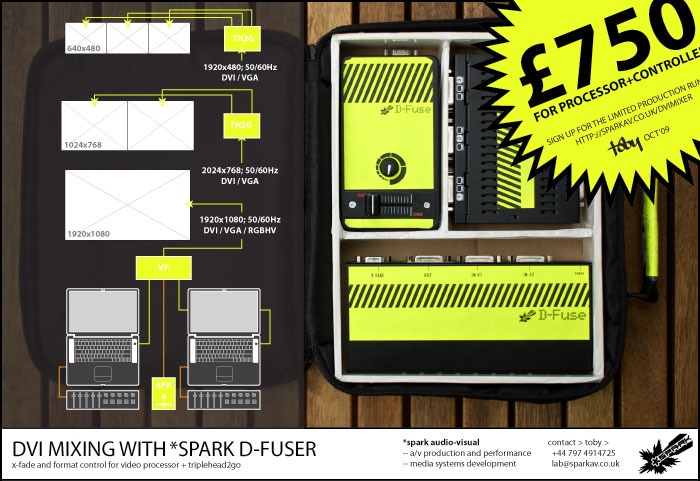
A video processor with two DVI-I inputs and a single DVI-I output, capable of the video formats following. The output is locked to its own timebase, ensuring solid output regardless of inputs. The input’s EDID switches to the current video format so your laptop should automatically change to the current resolution. See the full-sized poster attached at the bottom of this page for how I envision it being used, which can be in concert with a Matrox TripleHead2Go to drive multiple screens.

640x480  | 50/60Hz | 
1024x768 | 50/60Hz |
1600x600 | 50/60Hz | Timed as per Matrox TripleHead2Go, Dual 800x600
2048x768 | 50/60Hz | Timed as per Matrox TripleHead2Go, Dual 1024x768
1920x480 | 50/60Hz | Timed as per Matrox TripleHead2Go, Triple 640x480
1920x1080 | 50/60Hz | ie. 1080P

For the D-Fuse performance Particle, we use the prototype combined with a Matrox TripleHead2Go Digital Edition, wired with DVI cables from Laptop to Processor to TripleHead2Go, and then use DVI-VGA dongles on the TripleHead’s output to feed VGA to the projectors. Note it doesn’t have to be all DVI, the processor will happily process VGA instead, just get yourself some adapters.

  • The community angle

By aggregating our orders we can get something more refined than what is possible to any of us individually. Currently, there are a number of footnotes in the setup of the controller and processor. This is where the firmware revision comes in: the video processor as available to any of us presently works but there are a number of issues in terms of setup. They are resolvable, but it boils down to this: the larger bulk order that can be placed for the video processor, the more the manufacturer is willing to tweak the device. And beyond the “can the number of EDID slots be increased to handle six resolutions in both 50&60hz” kind of issues, I’m hoping we can get a bit more creative: ‘add’ as well as ‘over’ blend modes, for instance.

  • My role

To be clear, I am approaching this as a community based project to get this out there, rather than becoming a consumer electronics company myself. I see the opportunity to join the dots between a community with pent up demand for such a device, a manufacturer of a product that would not sell to this community otherwise, and some small scale manufacturing and development to make it all happen.

  • You want one yesterday

There is one remaining thing: testers. My prototype works for me, but that is a sample of one, and I know how the processor’s on-screen menu works. If you need one right here now, are willing to buy the parts upfront, and are not afraid of a soldering iron, get in touch.

  • Where we are now
  1. July’09 > D-Fuse and *spark have a prototype controller and video processor. Crossfade and Fade to Black work. Fader response time, video format and EDID control need some tweaking; the processor’s OSD is still needed.
  2. September’09 > I have spoken with the video processor manufacturer about enhancing the model’s firmware.
  3. October’09 > This page published, expression of interest form published.
  4. March’10 > Shawn Bonkowski helping with hardware.
  5. May’10 > Anton Marini aka Vade testing processor with pooled VJ kit from all over NYC
  6. June’10 > Prototype in form of final unit working. PCB layout still not complete.
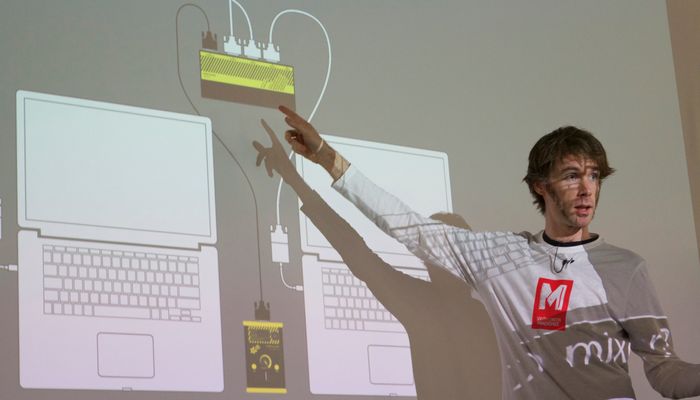
  7. June’10 > Presentation, reveal of the latest prototype, and hands-on demo at Visual Berlin festival. See embedded video, or in HD at vimeo

Updates as they happen are in the diary with the dvi mixer tag.

  • A final note

This is a personal project page about something I’ve made. I would like to be a catalyst to make some of the ideas on this page happen. I would like to put buyers in contact with sellers. Any contract and/or responsibility will be between them. I expressly disclaim all warranties of any kind. Nothing herein shall be deemed to create any partnership, agency or contract of any kind. I am not a shop, that poster is a bit of fun. You get the idea.

  • And now you’ve read through to the bottom, here’s where to sign-up

*spark d-fuser expression of interest form | closed (see http://tobyz.net/project/dvi-mixer)

project | 2009 | downloads: spark-dvimixer-berlinprototype.jpg · spark-dvimixer-electrovision-jul09.JPG · spark-dvimixer-poster-v002.png

dorkbot / quantifying progress

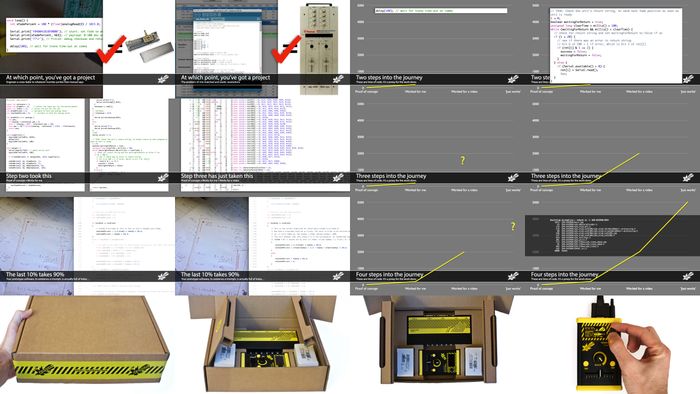
gave a lightning talk at dorkbot – we all know that a hack ain’t production-grade, well here’s me quantifying that.

taking stock: what made a maker business’ is far too big a talk to give at dorkbot, but this little excerpt made for a perfect bite.

diary | 11 jun 2024 | tagged: dvi-mixer · code · pervasive media studio · dorkbot

Taking stock: what made a maker business

Kickstarter pitches are now part of maker culture, but when do you hear back from the other side?

How did an Arduino hack turn into £50k in pre-orders? How do you get an assembly line going if all you have is a laptop? Four production runs and a retail partnership later, what were the final accounts?

Join Toby Harris as he talks product and dissects a successful run of a maker business.

A talk about the *spark d-fuser, which retailed on sparklive.net and has a project page with diary posts here.

project | 2019

bristech » taking stock: what made a maker business

how to network in a new town? i schemed going to talks is good, but giving a talk is better. plus it would be a good prompt to develop the definitive version of the ‘taking stock’ talk, the nascent version of which i’d made for the 2014 Mini-MakerFaire we effectively launched South London Makerspace at.

Kickstarter pitches are now part of maker culture, but when do you hear back from the other side?

How did an Arduino hack turn into £50k in pre-orders? How do you get an assembly line going if all you have is a laptop? Four production runs and a retail partnership later, what were the final accounts?

Join Toby Harris as he talks product and dissects a successful run of a maker business.

// About Toby

A product-focussed generalist with a soft spot for python and a CV that includes getting a robot to do stand-up comedy.

Bristech Meetup, 5th September 2019

there is a recording, though as with makerfaire there was a hitch; this time the audio starts a few minutes in and the video a few minutes after that.

enjoyed the talk before me, too –

diary | 05 sep 2019 | tagged: taking stock · dvi-mixer · talk

taking stock: from arduino hack to shipping product

it’s common to hear people talk about the beginnings of projects, but rare to witness a post-mortem. doubly so in the world of kickstarter: the pitches are now part of maker culture, but where’s the venue for a summing-up at the end?

i wanted to do that. with what could be called the modest success of the *spark d-fuser, i had something i could be proud about. moreover, and this probably gets to the heart of the issue, without the disincentives of stratospheric success shrouding the business in secrecy or abject failure making me want to crawl into a hole or quietly move on.

and where’s the venue? well, elephant and castle mini-maker faire seemed a good place to get a draft together and punt it out.

it’s still a work-in-progress, to be done when the last mixer is sold and accounts reconciled, but nonetheless it’s great to have the bones together.

diary | 15 oct 2014 | tagged: taking stock · slms · dvi-mixer · talk

d-fuser and 4x1024x768

back in 2009, the d-fuser was conceived to mix ‘triplehead’ dvi. it was a direct need for d-fuse’s live shows, along with HD. that story is long told.

then in 2011, the datapath X4 was released. it’s a triplehead2go on steroids, coming from the pro-av market rather than gamers. still, surprisingly affordable for what you get, which is a 1-in, 4-out dual-link dvi box where each output is completely configurable. before even getting to running quad-head, you could take triplehead input, split that to three outputs, and then use the forth to scale that non-standard 12x3 input back to something you could display on a monitor on your desk. i like, a lot[1].

it was a while until we got our hands on one at d-fuse HQ, but we did, and now the d-fuser can work with one too. of course, this has all happened since the firmware was commissioned and plans went to the factory, so the retail units don’t ship with this support. having just stepped through the process for the guildhall school of music and drama’s purchase of two d-fusers and an X4 for their scenography work[2], i’ve packaged up and made good the resources necessary. it’s not quite ready for http://sparklive.net/dfuser/support yet — it involves a windows pc, amongst other things — but the process works, and i’ve even got a nice align grid and 4x1 to 2x2 pixel map and test movie rolled in there.

so - attached is a zip of files with the resources you need to configure 2048x1536@30Hz through your d-fuser and 2048x1536@30Hz to 4x 1024x768@60Hz through the X4.

SparkDFuser-DatapathX4Support-v1.zip
  Align Grids
    SPK Align 2048x1536.png
    SPK Align 4096x768.png
  D-Fuser Controller Setup
    _See support site for firmware v30 and above_
  D-Fuser Processor Setup
    Windows CorioTools SPK-DF-750 v423 with X4.zip
  Datapath X4 Setup
    spark dfuser - datapath X4 configure script
  Pixel Map
    Spark D-Fuser X4 4x1 to 2x2 Pixel Map.qtz
    SPK Align 4096x768 30fps Bar.mov 

i didn’t see many config scripts for the X4 when i wrote my first, so here’s the configure script from the zip in plain, google-searchable, text.

#!/bin/sh

echo '### Datapath X4 Configuration for *spark d-fuser'
echo '###'
echo '### http://sparklive.net/dfuser/support'
echo 

if [ ! -x '/usr/local/bin/vqscmd' ]
then
  echo 'Error: Missing Mac OSX software for X4'
  echo '       Download and install from www.datapath.co.uk'
  exit
fi

echo 'Setting input format to 2048x1536 30Hz'
/usr/local/bin/vqscmd -DeviceNumber=0 -InputEdid=1,2048,1536,30000

echo 'Setting output format to 2x2 grid of 1024x768 60Hz'
/usr/local/bin/vqscmd -DeviceNumber=0 -OutputMode=1,1024,768,60000,1
/usr/local/bin/vqscmd -DeviceNumber=0 -OutputSource=1
/usr/local/bin/vqscmd -DeviceNumber=0 -CaptureRegionDefault=0

echo 'Saving settings in X4'
/usr/local/bin/vqscmd -DeviceNumber=0 -Commit

  1. its noisy fan and bulky power supply, less so. ↩︎

  2. first use of which was this: a bright spring day spent in a dark concrete cellar… ↩︎

diary | 23 mar 2014 | tagged: dvi-mixer · quartz composer · video-out | downloads: SparkDFuser-DatapathX4Support-v1.zip

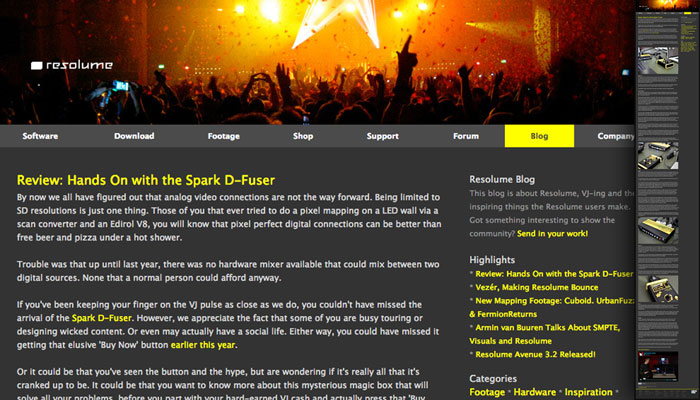
*spark d-fuser » resolume review

If you’ve been keeping your finger on the VJ pulse as close as we do, you couldn’t have missed the arrival of the Spark D-Fuser. However, we appreciate the fact that some of you are busy touring or designing wicked content. Or even may actually have a social life. Either way, you could have missed it getting that elusive ‘Buy Now’ button earlier this year.
Or it could be that you’ve seen the button and the hype, but are wondering if it’s really all that it’s cranked up to be. It could be that you want to know more about this mysterious magic box that will solve all your problems, before you part with your hard-earned VJ cash and actually press that ‘Buy Now’ button.
Either way, we’ve had the pleasure of working with that little bad boy on various occasions, as well as seen it in use by quite a few touring VJs. So we figured it was high time to give a first hand experience of what the D-Fuser actually defuses.

it’s a fun and informative review, and who doesn’t like being told they rock.

above the detail and any quibbles, there’s two meta-comments about the mixer that i really appreciate resolume making. the first is that “the *spark d-fuser is a new mixer for a new age”, with the review leading the reader from the act of vjing where the hardware mixer is the central instrument to where we are now: the sophistication and breadth of software is the prime driver, and so everything should be built around that. second, is that the *spark d-fuser is in many ways a hardware equivalent of resolume - it is a carefully designed product with a honed rather than expansive feature set, a product entirely built around the user experience for the user.

Now go press that ‘Buy Now’ button, everyone.

http://resolume.com/blog/review-hands-on-with-the-spark-d-fuser

diary | 12 aug 2013 | tagged: dvi-mixer · vj

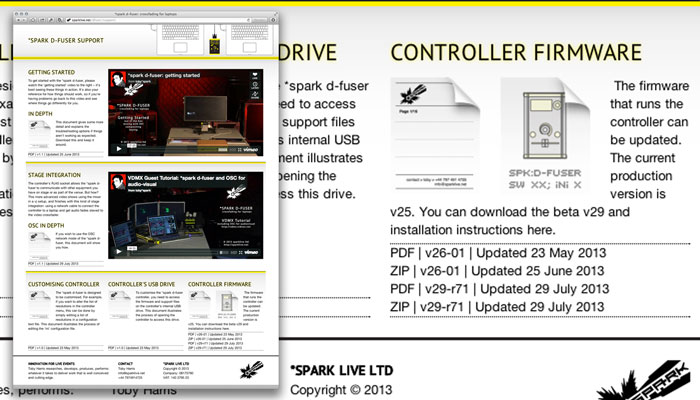
*spark d-fuser » v29 and more

a milestone in post-retail *spark d-fuser life - there are compelling new firmware revisions for the controller, and a support website that backs that and more.

notably, i’ve assembled a guide based on people’s experience beyond the getting started video, so now there is an extensive document that details use, what you need to know around mixing with DVI/HDMI/VGA, and what to try if things aren’t working out.

headline features from the controller firmware v25 to v29 are
keying - tweaked keys are now remembered, you can key right-over-left as well as left-over-right, and the menu / user experience is much better.
resolutions - better user experience; fit/fill/1:1 implemented for mismatching sources and output; 24 and 25fps HD modes are listed by default.
network - better implementation of OSC / ArtNet / DMX modes, plus detailed OSC how-to document.

all at http://sparklive.net/dfuser/support

diary | 30 jul 2013 | tagged: dvi-mixer · vj

*spark d-fuser » enter stage at edc

leaving the desert sun behind desert sun we’re now deep into the night: ali demirel tripping the light fantastic for richie hawtin’s enter stage at EDC las vegas. photo taken by the perfectly portraited barbara klein.

diary | 22 jun 2013 | tagged: dvi-mixer · vj

*spark d-fuser » desert engines

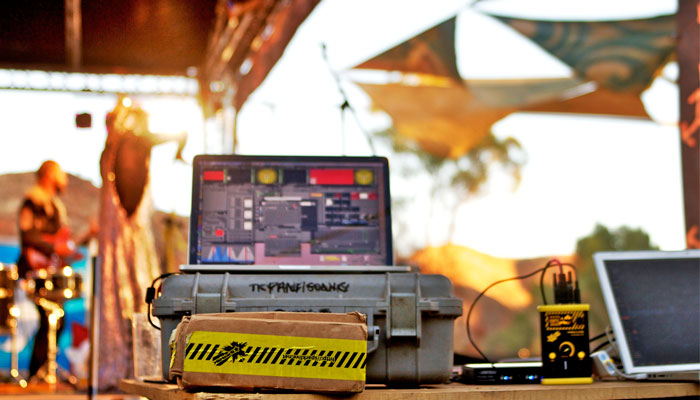
happiness is seeing photos like this: prototypes and factories far behind, a d-fuser out in the wild. truly the wilds here, courtesy of sean healey and his audio-visual performance ‘desert engines’. was it almost a year ago he was interviewing me as this whole endeavour was announced, prototype to pre-order?

diary | 16 jun 2013 | tagged: dvi-mixer · vj

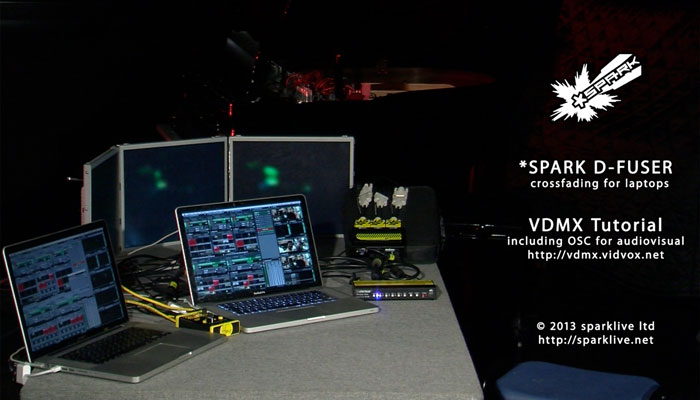
*spark d-fuser » osc and a/v tutorial

prompted by the vidvox feature, a guest tutorial video showing vj use of the d-fuser, complete with a demonstration of how you can link the d-fuser controller with your laptops for better audio-visual integration when performing as a group.

http://vdmx.vidvox.net/tutorials/using-the-spark-d-fuser-with-vdmx-with-toby-harris

diary | 05 apr 2013 | tagged: video-out · dvi-mixer · *spark · vj

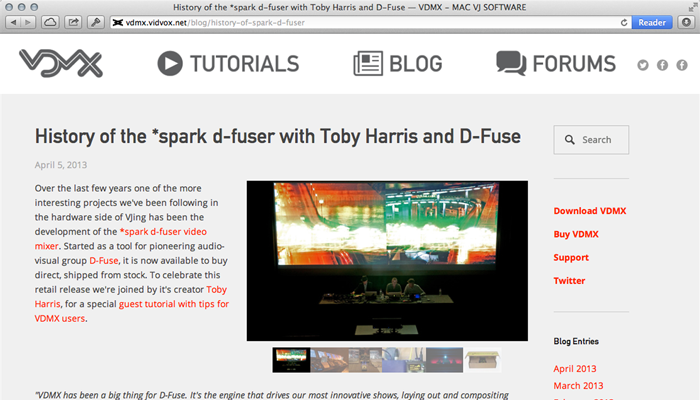
*spark d-fuser » vidvox feature

“VDMX has been a big thing for D-Fuse. It’s the engine that drives our most innovative shows, laying out and compositing footage across multiple screens, hosting patch upon patch of custom D-Fuse development work. However, for our kind of theatrical shows, plugging a laptop directly into the projection setup just isn’t an option. We need video hardware to keep a solid feed to the projectors from early soundcheck to us walking on stage, we need to have a master fade control for our output, and we need to crossfade between our laptops to mix collaboratively. For year after year there was no solution to this, as with each laptop rendering all screens simultaneously the video format is outside of what the SD and then HD hardware can handle. What we needed was a DVI mixer. There wasn’t one, and so I made one.”

http://vdmx.vidvox.net/blog/history-of-spark-d-fuser

diary | 05 apr 2013 | tagged: dvi-mixer · vj

b-seite » *spark's stall out again

b-seite charge one: provoke vjs into thinking about the future of their practice, via showing the toys and talk about how i made it as a post-vj. this was a tidied up version of the talk i improvised at LPM last year, except that then the mixer was a final prototype, and here I was at a festival with two d-fusers as part of their tech setup. mixer’s i’d sold but had never seen, the boxes opened up by hands other than mine, in a country far away.

diary | 23 mar 2013 | tagged: titler · dvi-mixer · *spark · vj · b-seite · talk

*spark d-fuser » factory, take two

back at the factory to check on more d-fusers being made. don’t think i’ll ever quite get over seeing other people making my things in bulk.

diary | 19 mar 2013 | tagged: dvi-mixer · vj

*spark d-fuser » to retail

turning the dvi-mixer project into the *spark d-fuser product was very much an act of faith that peer demand meant something. but in no small part too, it was an act of hubris: i said i was going to do this thing, and i found i wasn’t at all happy looking at it fizzling away before the 2012 reboot. put those two things together, and you will likely decide to offer a pre-ordering window, and pledge to make as many are as ordered. it could be two, twenty, or two hundred; a loss at the low-end, a profit at the high end, but one way or another they were going to get out there.

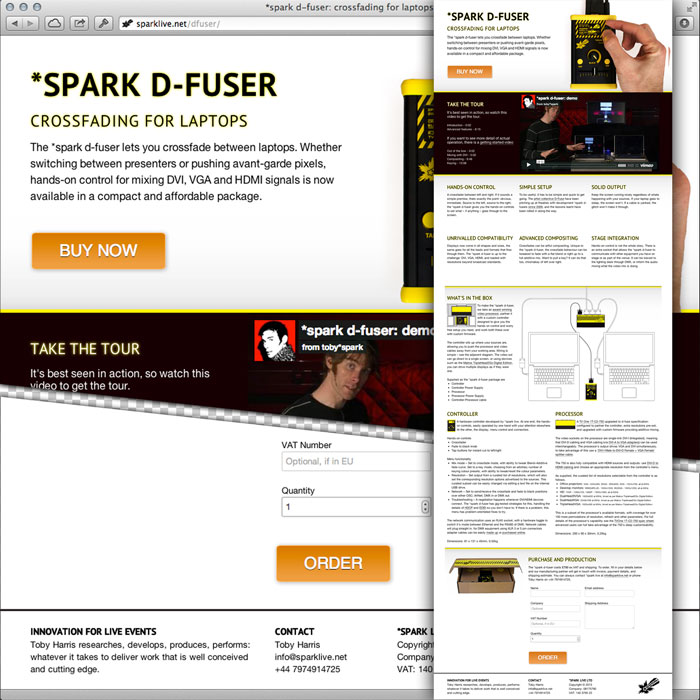
but this is not how people expect to buy a product, nor is it how the world is set up to let you sell products. with daily enquiries from people too late to get in on that first run, december and january saw me getting to the point where the *spark d-fuser could become a retail operation. the face of this you can see in the completely reworked website pictured above, but the big development is partnering with a company to take on the logistics of the d-fuser as a retail operation. it’s a company i used for some parts of the original production run, that worked out well so they’re now my manufacturing partner with orders going directly to them.

all which is quite a preamble to a simple fact: there’s now an order button. go use it!

diary | 07 feb 2013 | tagged: dvi-mixer · *spark · vj

dvi mixer - a production runs worth of updates

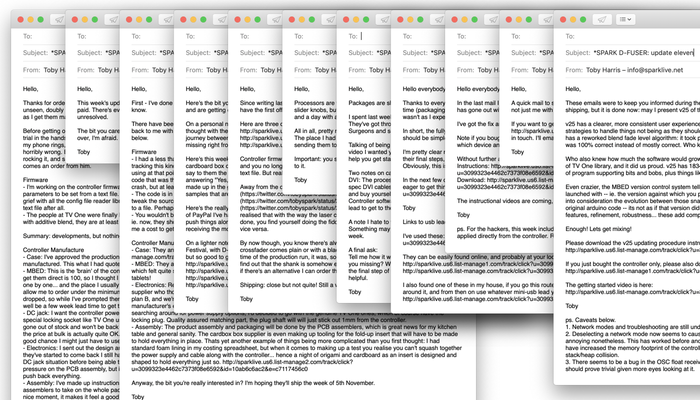
with the production run now done, for posterity here is what it took, as evidenced by the update emails i sent out to everybody whose future-mixer was being made.

Hello,

Thanks for ordering a *spark d-fuser, you’re one of 80. I realise its quite a thing to put your money down on something sight unseen, doubly so something that has yet to get through its manufacture run. So I’m going to do my best to keep you in loop as I get them manufactured and out to you.

Before getting onto the production status, here’s a little story. While the orders were open, the prototype was out on a field trial in the hands of Jim and Adam of As Described, who were running a stage at the Bestival weekend. Saturday morning, my phone rings, and its Jim on the other end. This makes me worried: I assume he’s ringing because something has gone horribly wrong. But no: its a very excited Jim, reporting a great night VJing with the mixer, guest acts such as Pfadfinderei rocking it, and saying Matt Black of Ninja Tune saw it and asked straight away how could he order one. And later that day, in comes an order from him.

Firmware

  • I’m working on the controller firmware to read in settings from a configuration file, aiming for the resolution menu and keying parameters to be set from a text file. I was hoping to say this was done by the time of writing this email, but I’ve been having grief with all the config file reader libraries I can find. At this rate I might just roll one myself, its only reading in lines from a text file after all.
  • The people at TV One were finally back in the office, and while I still haven’t got a firm answer about the processor firmware with additive blend, they are at least making positive noises.

Summary: developments, but nothing definite yet.

Controller Manufacture

  • Case: I’ve approved the production sample and transferred the payment for 85 machined and printed cases to be manufactured. This what I had quoted at 5-6 weeks, and has gone off within the first week, so we’re still on track here.
  • MBED: This is the ‘brain’ of the controller, and is a £40 part a bit like a Arduino on steroids. The minimum order quantity to get them direct is 100, so I thought I was in the bad position of having to find 80 plus spares through places that sell them one by one… and the place I usually use was out of stock. The great news is that they’ve managed to bend their system to allow me to order under the minimum quantity. The not so great news is that their hand over to their sales department got dropped, so while I’ve prompted them and its back on track, I still haven’t been able to commit to the order, and there may well be a few week lead time to get them to me.
  • DC jack: I want the controller power supply to be interchangeable with the processor’s power supply. This meant finding the special locking socket like TV One use on the processor, which I had done and tested its fit. Unfortunately that part has now gone out of stock and won’t be back in stock till the end of the year. I’ve found an alternative, and while I’d have to order 500 the price at bulk is actually quite OK. But that has an eight week lead time. I haven’t made a decision on this yet, but there’s a good chance I might just have to use a generic non-locking jack. Its not the end of the world, but it is a bit of a shame.
  • Electronics: I sent out the design and bill-of-materials to get quotes for manufacture and assembly of the PCB, and while they’ve started to come back I still haven’t had them all back. They’re looking ok so far, but I need to resolve the MBED and DC jack situation before being able to get that going. With the lead time of 5-6 weeks for the case, I thought there wouldn’t be pressure on the PCB assembly, but if the MBED supply means this can’t start for a few weeks, that might change things and push back everything.
  • Assembly: I’ve made up instructions for assembly of the complete controller. We’ll see whether its economic for the PCB assemblers to take on the whole package, or whether its me who slips the PCBs into the slot in the case. Regardless, its a nice moment, it makes it feel a good step ‘more real’.

Summary: waiting on a quote or two, possible delay due to MBED sourcing.

Toby


Hello,

This week’s update. At the end of week two the totalling and quoting for the controllers is done, company chosen and monies paid. There’s even an assembly and test document, if not the actual test rig or code setup. The TV One situation is still unresolved.

The bit you care about: when? The controller manufacture is stated at five weeks, which starts Monday. So thats one week over, I’m afraid.

Toby


Hello,

First - I’ve done this update mail through the service I’m using to handle future production run enquiries, any issues let me know.

There have been two weekends without updates - apologies. I should have known better than to wait on somebody getting back to me with an update, and definitely known better than to let that happen twice! I have been busy though, updates below.

Firmware

  • I had a less than fun weekend realising there was a crashing bug in the controller code. Without a proper a debugger tracking this kind of thing down is a nightmare, especially when you read a load of internet posts about the library you’re using at that point displaying just the behaviour you’re seeing. Inevitably, the mbed library turns out to be faultless and it my code that was the problem. An edge case in my optimised TV One comms code was quietly setting the stage for a later crash, but at least its fixed now and I’ve learnt a thing or two in the process.
  • The code is in there to work with resolutions and keyer settings read from a config file – much better for you than having to tweak the source code – but I still haven’t got a library running as part of the firmware that actually reads and writes settings to a file. Perhaps more eyes on that will solve it trivially, its probably a compile problem or suchlike.
  • You wouldn’t believe it, but TV One still haven’t given me an answer on the additive firmware. But by the ‘end of the week’, ie. now, they should ‘have something to show me’ and a development cost. It seems they’re doing the work before quoting me a cost to get my approval? Next week I’ll be able to say, surely!

Controller Manufacture

  • Case: They arrived this morning, and the quality is outstanding. Boom! Really stoked. http…
  • MBED: They arrived ahead of schedule and are at the assemblers. Getting them direct means dealing directly with ARM, which felt quite surreal: invoices and letterheads from the architects of the chips that power pretty much all smartphones and tablets!
  • Electronics: Remember that DC-In issue? Well this is where the news gets more annoying. Long story short, I had a supplier who thought they could source that part, and two weeks later found out that they couldn’t, so we’ve had to make a plan B, and we’re delayed. The controllers will now come with a non-locking part, and I’ve ordered that 500 lot of a UK manufacturer’s equivalent part just so this never need happen again. This is doubly annoying, as by this point after much searching around for power supply options, I’d decided to go with the genuine TV One ones, which of course have the locking plug. Quality assured matching part, the plug shaft will will just stick out 1mm from the controller.
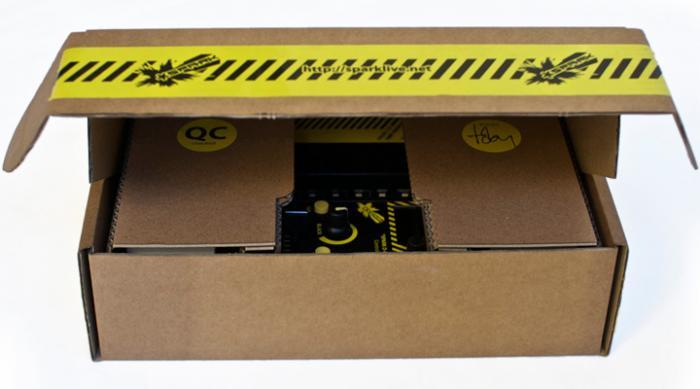
  • Assembly: The product assembly and packaging will be done by the PCB assemblers, which is great news for my kitchen table and general sanity. The cardbox box supplier is even making up tooling for the fold-up insert that will have to be made to hold everything in place. Thats yet another example of things being more complicated than you first thought: I had standard foam lining in my costing spreadsheet, but when it comes to making up a test you realise you can’t squash together the power supply and cable along with the controller… hence a night of origami and cardboard as an insert is designed and shaped to hold everything just so. http…

Anyway, the bit you’re really interested in? I’m hoping they’ll ship the week of 5th November.

Toby


Hello,

Here’s the bit you’ll like and makes me super happy: TV One are going to develop the custom firmware, have been paid for it, and are getting on with it.

On a personal note, adding additive mixing was pretty much the reason I put this project out to the community back in 2009. I thought with the leverage of many TV One could be persuaded to tweak the 750. Didn’t quite prove that simple and while the journey between then and now has been frankly crazy making, at least there’s the reward of the feature as an artist I felt was missing right from the start.

Here’s this week’s standard bit of production WTF: I’ve just spent the best part of two weeks going back and forth with a cardboard box company to find out that they couldn’t in fact do the basic job I’d asked them about in the first place. When you say to them the sample box is good but can it be made up of a better grade of cardboard, there’s quite a difference in answering “Yes, we have lots of grades of cardboard” instead of “Well, we have lots of cardboard but that box can only be made up in the grade we sent you”. Especially when they’re going to spend the next week working up tooling quotes and samples that are specific to the exact properties of that box. That can’t exist.

Here’s the really horrible side you don’t ever want to know about: despite having got all payments up-front, with the wonders of PayPal I’ve had an oh-so-interesting time actually accessing that money. I’ve had to put in £10k of my own money so far to push things along, and its just occurred to me I’m probably going to have to pay the VAT on all the sales before actually receiving the money for half of the sales. Which could make that figure a lot higher. Gah.

On a lighter note, this week saw some pretty pictures going through the prototype for the opening concert of the Belfast Festival, with D-Fuse providing a visual score to Holst’s The Planets. Plenty of power politics and setup stress at such things, but so good to get back in the mix.

Toby


Hello,

Since writing last time, I’ve spent a day in a lab coat at the factory. They’re getting on with the final build and testing, and I have the first off the production line in front of me here. Huzzah!

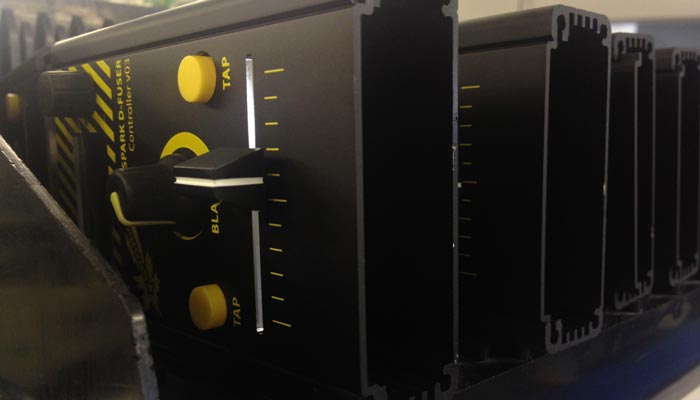
Here are three diary posts from the factory, and a shot of the real controller. A drawing no more!

Controller firmware is up to v21, there’s a lot of code and time in there. I’m quite proud of the way it handles additive mixing, and you no longer need to hack the code to change things like the resolutions in the menu system: its reading settings from a text file. But really all the effort is about smoothing the edges of the TV One unit. Hopefully it does, more and more.

Away from the digital anvil, I’ve sanded 100 menu knobs down to fit (https://twitter.com/tobyspark/status/263411649485094912), the packing tape came in handy sooner than expected (https://twitter.com/tobyspark/status/263412216122970113), and I’ve got there with the packaging (https://twitter.com/tobyspark/status/264152349923237888). Although since that photo, I’ve chucked it down the stairs and realised that with the way the laser cutter works, I need to cut from the bottom not the top for strength… so just when you’re done, you find yourself doing the fiddly business of changing all the cut marks so valley folds become mountain folds and vice versa.

By now though, you know there’s always a spanner thrown in the works somewhere. Here follows this week’s. The crossfader comes plain or with a black dust cover over the slot. I wanted that black version, but it was never in stock. By the time of the production run, it was, so with some minor joy I ordered them. Of course, getting the assembled PCBs back now, I find out that the shank is somehow ever so slightly different on them, my 100 slider knobs don’t fit any more, and I’m not sure if there’s an alternative I can order that will. Gah!

Shipping: close but not quite! Still a week.

Toby


Hello,

Processors are waiting to be shipped to me. Custom firmware for the processors is in my hands. Controllers don’t have their slider knobs, but a plan is in action. Controller firmware is done. Packaging is designed, my hall full of 100 cardboard boxes, and a day with a laser cutter awaits to make up the inserts.

All in all, pretty much there. It will take a few days of sitting in a warehouse upgrading processors, folding boxes and whatnot. The place I had lined up turns out to not be free next week, which is kinda annoying, however my main worry is actually sending them to the right addresses: looking at the list from PayPal, some don’t look quite right.

Important: you should receive an individual email from me at some point today confirming address. Please make sure to reply to it.

Toby


Hello,

Packages are shipping!

I spent last week setting things up so that this week the kitting company can package up the boxes and send everything out. They’ve got through most of the orders now and will be done by Tuesday. I’ve just got back from London peers The Light Surgeons and seen theirs arrive. If I wasn’t writing this through the fug of a cold, I think I’d be thrilled =]

Talking of being ill, this week has been a write-off and I haven’t made the ‘take it out the box and plug everything in’ demo video I wanted you all to have by the time you received your mixers. It will come, but in the meantime, feel free to hit me up to help you get started: email operator@tobyz.net and we’ll take it from there, I’m rarely far away from the email.

Two notes on cables:
DVI: The processor is only single-link DVI, so there is no benefit in using dual-link cables. Back in 2009 I bought the highest spec DVI cables I could find and have been lugging around these heavy cables that barely bend ever since! If you need to go and buy yourself some DVI cables, I’d recommend thinner, flexible, cheaper single link ones over ‘premium’ ones.
Controller software and power-on settings: Its open to you to tweak and upgrade, to do so you’ll need a right-angle mini-USB lead to get to the socket inside.

A note I hate to write:
Something may not be right with the additive mixing bonus feature. I will see what is what, and what can be done, in the next week.

A final ask:
Tell me how it works out for you! It would be great to hear about your unboxing experience and first use. What information are you missing? What doesn’t work as you’d expect it? Also I need to know how reliable the kitting company has been in doing the final step of the process with me not there. A photo or two of the state of the mailing bag / box / insides would be really helpful.

Toby


Hello everybody,

Thanks to everybody who has sent feedback. I’ve learnt a few things, some of which are for me to do better if there is a next time (packaging - I’m looking at you), but some of which need addressing here and now. I’ve had a hunch that something wasn’t as I expected with the shipped units, and have now verified this.

In short, the fully tested hardware has gone out with the software/settings not applied correctly. I am working on a fix. It should be simple. Apologies to all.

I’m pretty clear now on the sequence of events that led to this, and while my manufacturing partner has let me down bad on their final steps, I can’t push all the blame to them: there’s also a problem in the controller software that is my fault alone. Obviously, this is annoying for so many reasons.

In the next few days, I’ll have videos detailing everything. You’ll need the mini-usb lead I’ve mentioned previously. If you are eager to get things going today, follow the software available online (http…).

Toby

Links to usb leads –

I’ve used these: http…

They can be easily found online, and probably at your local computer shop.
http…

I also found one of these in my house, if you go this route you can leave the adapter plugged in and close the case back around it, and from then on use whatever mini-usb lead you have to hand.
http…


Hello everybody,

In the last mail I wrote: I’ve had a hunch that something wasn’t as I expected with the shipped units. The fully tested hardware has gone out with the software/settings not applied correctly. I am working on a fix. It should be simple. Apologies to all.

I’ve got the fix and documented its application.

Note if you bought the controller alone, I’ll send a follow-up with the specific instructions and downloads for you tomorrow - which device and TVOne firmware you’re running complicates things.

Without further ado -
Instructions: http…
Download: http…

The instructional videos are coming, this has consumed my time so far.

Toby

ps. For the hackers, this week included reverse engineering the missing factory step that required a PC so that it can now be applied directly from the controller. Rock!


Hello,

A quick mail to say the v24 software for the controller is developing further in response to feedback from some of you. Now its not just me with a controller, I’m having a few people beta test the updates, which is proving really helpful.

If you want to get the fixes, check the latest and put in any feedback before I push out what should be the final version, check http… and get in touch. I’ll email again when its done.

Toby


Hello,

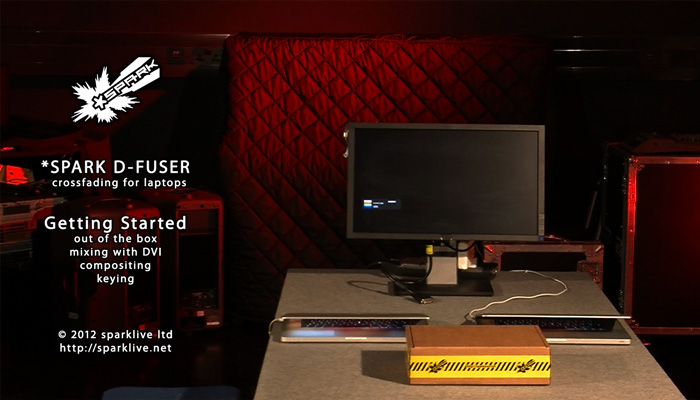
These emails were to keep you informed during the production process. That process turned out not to finish with them shipping, but it is done now: may I present v25 of the controller software, along with the getting started video.

v25 has a clearer, more consistent user experience. Behind the scenes, it keeps a much closer eye on the processor and has strategies to handle things not being as they should. It handles processors with different versions of TVOne firmware. It even has a reworked blend fade level algorithm: it took pages of diagrams and equations to get past my intuition to something that was 100% correct instead of mostly correct. Who knew crossfading could be so tricky!

Who also knew how much the software would grow. The arduino code for the first gig had 68 lines of program and 128 lines of TV One library, and it did us proud. v25 has 1834 lines of program, 1047 lines of TV One library, around a thousand lines of program supporting bits and bobs, plus things like the OLED library I wrote from scratch. Crazy!

Even crazier, the MBED version control system tells me 2124 lines of code have changed between the version of software I launched with – ie. the version against which you placed your orders – and the version I’m releasing to you now. If you took into consideration the evolution between those snapshots, that number would be even higher. Thing is – and just like the original arduino code – its not as if that version didn’t work: its what was running for the demo video. Just that user-friendly features, refinement, robustness… these add complexity, and seem to do it exponentially.

Enough! Lets get mixing!

Please download the v25 updating procedure instructions here:
http…

If you just bought the controller only, please also download this PDF and start there.
http…

The getting started video is here:
http…

Toby

ps. Caveats below.

  1. Network modes and troubleshooting are still undocumented at the moment.
  2. Deselecting a network mode now seems to cause the controller to crash - not something you do outside of studio tests but annoying nonetheless. This has worked before and the network code is unchanged from then. I think the developments since have increased the memory footprint of the controller and dynamically creating / deleting the network stacks can now cause a stack/heap collision.
  3. There seems to be a bug in the OSC float receive, and right now its beyond me to fix it. In the open source tradition, this should prove trivial given more eyes looking at it.

diary | 19 dec 2012 | tagged: dvi-mixer · vj

dvi mixer - with v25 and a video, first run done

the demo video upon which pre-orders were placed had prototype hardware; here now is a manufactured product, out of the shipping packaging, running the final v25 software. i say final, because as the units spread around the world that prototype is no longer the sole test-bed: v25 encodes feedback and testing from real customers. i’m proud of where i’ve got it to.

i never could have anticipated how much work it would take to get here – and it isn’t over, and there’s always scope for more – but right now, it all feels a good place to be, and that video a good point to draw a line. from here, let the videos start coming back, scenes exotic with a small black box with diagonal stripes somewhere in the mix…

diary | 19 dec 2012 | tagged: dvi-mixer · vj

dvi mixer - first pack

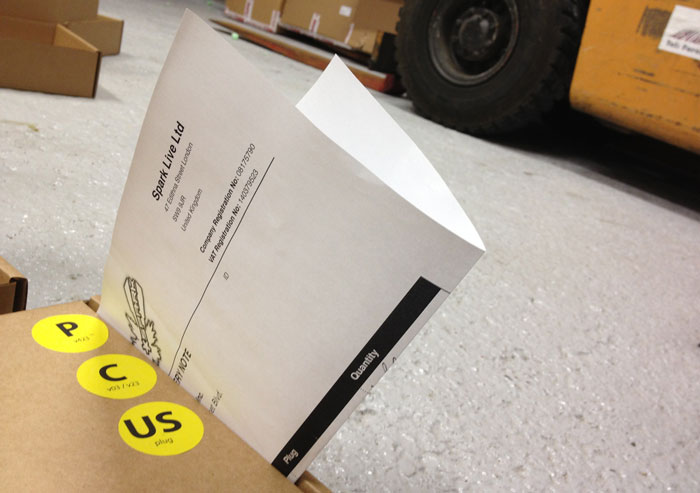
by rights, as the first off the line this should be sean healey’s, but the delivery note at the top of the pile was one for the US. but - this is it! the beginning of the end, the first packaged product.

a project no more: products, shipping.

diary | 21 nov 2012 | tagged: dvi-mixer · vj

dvi mixer - programmed processors

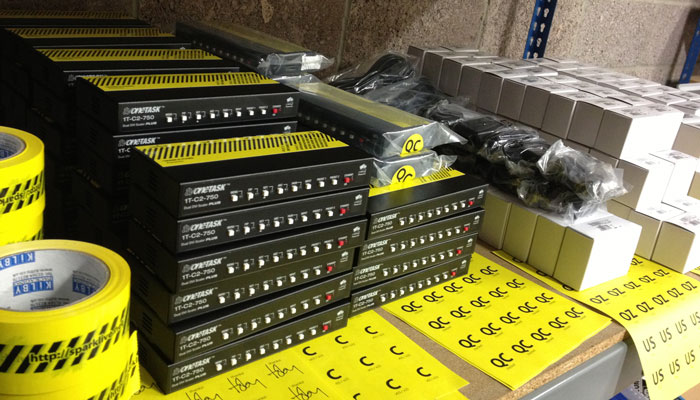
not just the solitary 1T-C2-750 that we, as D-Fuse, bought in the summer of 2009 any more! a shelf full of the things, all programmed up with custom firmware to do additive mixing. what you can’t see is the floor of the industrial unit laid out with a sea of boxes, ready to be assembled up and shipped off.

diary | 19 nov 2012 | tagged: dvi-mixer · vj

1

2

3