it’s a funny thing, handing in a thesis, submitting corrections and so on, but not being able to link anyone to the work. finally, so long after may, but at least not so long after the viva, here it is. all 169 pages of it.
an email comes in from a performance studies phd candidate asking if they could watch the whole robot routine from comedy lab: human vs. robot. damn right. i’d love to see someone write about that performance as a performance.
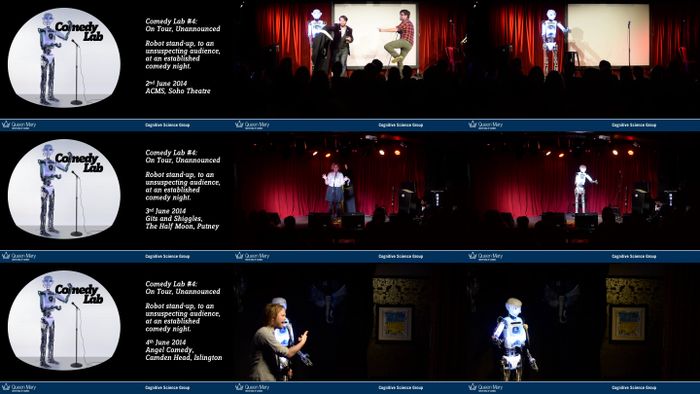
but, better than that staging and its weird audiences (given the advertised title, robo-fetishists and journalists?) there is comedy lab #4: on tour, unannounced. the premise: robot stand-up, to unsuspecting audiences, at established comedy nights. that came a year later with the opportunity to use another robothespian (thanks oxford brookes!). it addressed the ecological validity issues, and should simply be more fun to watch.
for on tour, unannounced we kept the performance the same – or rather, each performance used the same audience responsive system to tailor the delivery in realtime. there’s a surprising paucity in the literature about how audiences respond differently to the same production; the idea was this should be interesting data. so i’ve taken the opportunity to extract from the data set the camera footage of the stage from each night of the tour. and now that is public, at the links below.
the alternative comedy memorial society
gits and shiggles
angel comedy
the robot comedy lab experiments form chapter 4 of my phd thesis ‘liveness: an interactional account’
Four: Experimenting with performance
The literature reviewed in chapter three also motivates an experimental programme. Chapter four presents the first, establishing Comedy Lab. A live performance experiment is staged that tests audience responses to a robot performer’s gaze and gesture. This chapter provides the first direct evidence of individual performer–audience dynamics within an audience, and establishes the viability of live performance experiments.
there are currently two published papers –
robot stand-up: engineering a comic performance
http://tobyz.net/diary/2014/11/robot-standup-workshop-paper
robot comedy lab: experimenting with the dynamics of live performance
http://tobyz.net/diary/2015/08/robot-standup-journal-paper
and finally, on ‘there is a surprising paucity…’, i’d recommend starting with gardair’s mention of mervant-roux.
diary | 03 may 2019 | tagged: comedy lab · phd · qmat · research
i’m a co-author of Audience Interaction: Approaches to researching the social dynamics of live audiences, a chapter in the Routledge Companion to Audiences and the Performing Arts. at some point, it got a top to bottom re-write from pat, my phd supervisor. the topic being pretty much that of my phd, witnessing this re-write was quite something. for all those hours of supervision discussing, probing, honing… this is the distilled version of what was in his head; squint, and it’s as if he got to write my thesis instead. i’m proud of what i wrote and i think it holds up, so this was wild, in a good way. like watching a grand master, able to appreciate every detail.
Live events are social encounters: people in a live audience do not just react to a work, they react to the people around them. Other people’s laughter, applause, coughing, fidgeting, in-breaths and silences all contribute to the experience of live events. Importantly, these behaviours are not just clues to people’s inner responses – they are public social signals that are actively interpreted by others. As a result, there are a number of connections between the organisation of large-scale audience interactions and small-scale social interactions like conversation. These connections provide a useful way of thinking about the dynamics of audience responses. It has implications for what responses we focus on, how we measure them and how we model them. It helps to explain how responses develop and propagate through an audience. It also changes our understanding of what influences people’s moment-by-moment experience of live events; performers and audience members alike.
diary | 06 oct 2022 | tagged: research · phd · engaged audiences · writing
I think that is you done, so congrats!
and with that, it’s done. an academic book chapter submitted, tying together my art practice and the research it prompted. i’m proud of it, the writing has been a personal ordeal but the result is a defining statement on my position. i’m also proud of the form – it’s simultaneously a robust academic contribution grounded in empirical research and a highly personal account. quite radical, that.
diary | 17 nov 2025 | tagged: research · phd · live in live cinema · engaged audiences · writing